Leica is marking 60 years of the Noctilux, its famous family of ultra-fast lenses, with a 240-page anniversary book. The company announced it on November 11, and PetaPixel, Digital Camera World and Macfilos all covered the news this week. The book launches November 27 in Wetzlar, Germany, alongside a small “60 Years of Noctilux” exhibition.
We do not shoot Leica at Grey Bug Photography. Our event and headshot work in San Antonio is done on Nikon Z bodies. But the Noctilux story is a great excuse to talk about something every headshot client benefits from understanding: what a fast lens really does, and why the widest aperture is not always the best choice for your portrait.
The Noctilux in one paragraph
Leica introduced the first Noctilux, a 50mm f/1.2, at Photokina in 1966. Its goal was to capture light at night, which is where the name comes from. It was the first series-produced lens with aspherical surfaces, and fewer than 2,000 were made by hand. Later versions pushed to f/1 and then to f/0.95, breaking the f/1 barrier. A 75mm f/1.25 brought a focal length tuned for portraits, and the newest member is a 35mm f/1.2. One of the photographers featured in the book told Digital Camera World he felt it was the best lens in the world for capturing a face, because it pairs extreme sharpness with incredible softness.
What a fast lens does for a portrait
“Fast” means a lens has a very wide maximum aperture, a small f-number like f/1.2 or f/1.4. That wide opening does three things:
- It gathers more light. That is why the Noctilux was called “king of the night.” More light means lower ISO and cleaner files in dim rooms.
- It blurs the background. A wide aperture gives a thin plane of focus, so busy offices, hallways and conference banners fade into soft color.
- It separates the subject. Combined with a longer focal length, it makes the person (or the detail) pop off the frame.
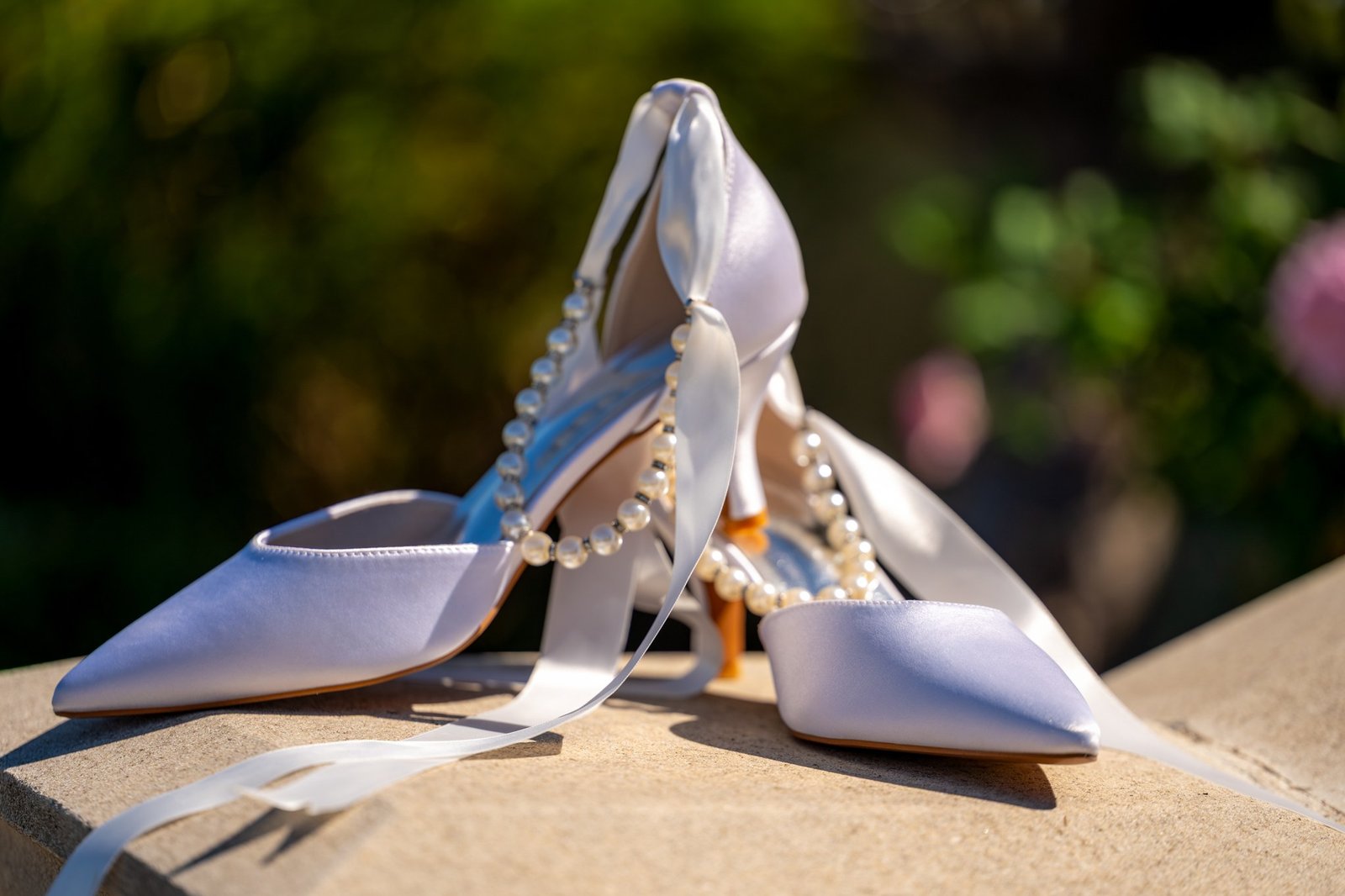
You can see the effect in the photo at the top of this post. It is a detail frame from a wedding, shot on our Nikon Z8 with the NIKKOR Z MC 105mm f/2.8 VR S at f/3. The garden behind the shoes was full of plants and flowers. At that aperture and focal length, it turns into a smooth wash of green that keeps attention on the pearls and satin.
Why wide open is not always right for headshots
The same thin focus that makes a dreamy portrait can work against a business headshot. At f/1.2 on a close portrait, the eyes can be sharp while the tip of the nose, the ears or the far shoulder already go soft. That look is beautiful for an artistic portrait. For a LinkedIn photo, a company website or a speaker bio, most clients want the whole face crisp and clean.
That is why many professional headshot photographers stop down to a middle aperture for corporate work and get background separation from distance and lighting instead. A few practical points for clients:
- Ask for consistency on team headshots. When a whole staff is photographed, matching backgrounds, light and depth of field matter more than any single lens.
- Background blur comes from more than the lens. Distance between you and the backdrop, focal length and lighting all play a part.
- Sharp eyes are non-negotiable. Whatever the aperture, the eyes should be tack sharp. Modern eye-detection autofocus on cameras like the Nikon Z8 and Z9 helps a lot here.
- Dim venues are where fast glass shines. At evening galas, receptions and ballroom events, a fast lens lets the photographer keep the room’s mood without blasting flash.
Fast Nikon Z lenses worth knowing
If the Noctilux anniversary has you thinking about fast glass for your own Nikon Z camera, these are the lenses to look at. The 105mm macro is the lens behind the photo above.
- Buy the NIKKOR Z MC 105mm f/2.8 VR S at Adorama (details, rings and tight portraits)
- See the NIKKOR Z 85mm f/1.2 S at Adorama (a classic fast portrait focal length)
- See the NIKKOR Z 50mm f/1.2 S at Adorama (the same focal length as the original Noctilux)
- See the Nikon Z8, one of our event and headshot bodies, at Adorama
Disclosure: some links in this post are affiliate links, which means Grey Bug Photography may earn a small commission if you buy through them, at no extra cost to you.
The takeaway
Sixty years after the first Noctilux, fast lenses are still loved for the same reason: they let a photographer control light and focus to point your eye exactly where it should go. For your headshot or event, the best choice is not always the widest aperture. It is the aperture that keeps the right things sharp and lets everything else fall away.
Sources: Leica Camera AG press release, “Noctilux: The Anniversary Book,” November 11, 2026; PetaPixel, November 11, 2026; Digital Camera World, November 13, 2026; Macfilos, November 12, 2026.
Need professional headshots for your team or photos of your next event in San Antonio or elsewhere in Texas? Reach out to Grey Bug Photography, or see how we work with planners on our For Planners page.