The camera everyone in photography has been talking about this fortnight is small enough to slip into a coat pocket. Sigma announced the Sigma FP2 on October 23, 2026, and it goes on sale on November 11. Sigma calls it the world’s smallest full-frame interchangeable-lens camera, and DPReview, Digital Camera World and iPhotography have all covered the launch. Digital Camera World also reports that early pre-orders at several major retailers in Japan have already used up the first shipment, so supply may be tight when it arrives.
We shoot events and headshots in San Antonio with the Nikon Z9 and Z8, and we have used both since each camera launched. A pocket-size full-frame body is not a replacement for those cameras. But it raises a fair question for anyone who hires a photographer, or shoots for a living: what is a camera like this actually good for? Here is a practical look at what Sigma announced and where it would and would not fit event and headshot work.
What Sigma announced
Based on Sigma’s launch notice and DPReview’s coverage, the highlights are:
- A 24.5-megapixel full-frame sensor. It is a partially stacked design, which means faster readout than the original fp from 2019.
- Up to 20 frames per second. DPReview says it can hold that pace for about 200 JPEG frames or 180 DNG RAW files in a burst.
- Tiny body. About 460 grams (16.2 oz) with the battery and card installed, with an L-mount for lenses from Sigma, Panasonic, Leica and others.
- Modular design. A 3.2-inch tilting rear screen is built in. An electronic viewfinder (the EVF-21) and a flash hot shoe are optional add-ons.
- Video features. Up to 6K open-gate recording, ProRes RAW output to an external SSD, and two USB-C ports.
- 70 GB of internal storage in addition to the SD card slot, and a rated battery life of about 370 stills per charge.
- Price. $2,199 for the body alone in the US, or $2,749 bundled with the EVF-21 viewfinder or with the I-series 50mm F2 DG lens.
Where a camera this small makes sense
For event and travel photographers the appeal is easy to see. A camera that disappears into a jacket or a small bag is handy for the moments when you do not want to carry a full kit:
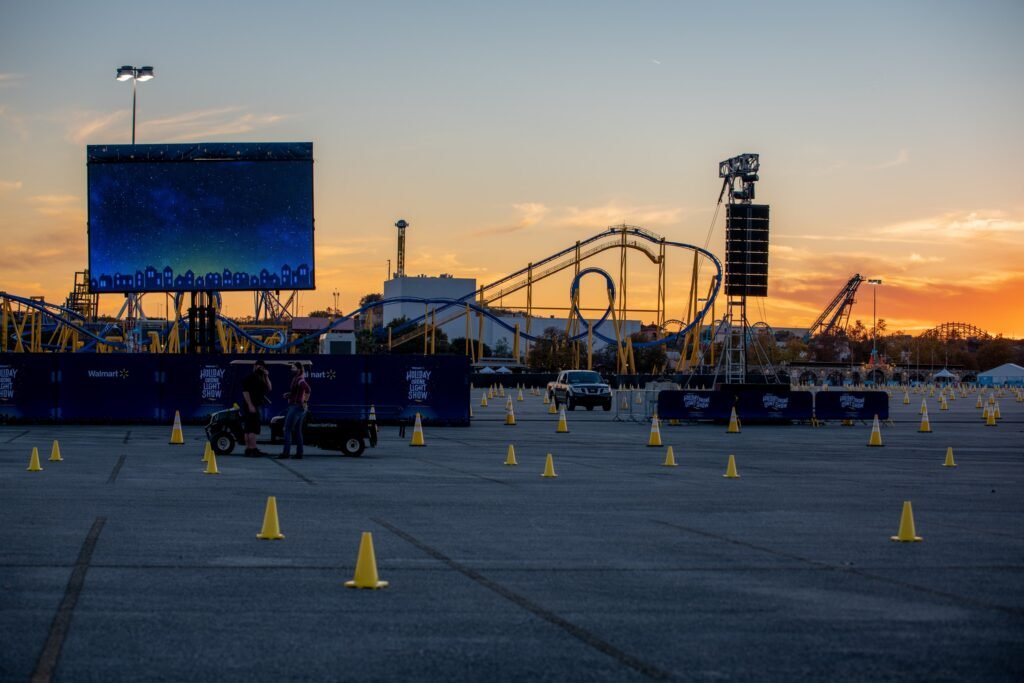
- Venue and setup photos. The image at the top of this post is a quiet golden-hour scene at a holiday drone light show venue before the crowd arrived. Walking a site early to capture the stage, screens and layout is exactly when a small second camera is nice to have.
- Behind-the-scenes and travel frames. Full-frame image quality in a body that does not draw attention.
- Video and B-roll. The 6K open-gate and external recording options are aimed squarely at hybrid shooters.
What would give us pause for paid event and headshot work
We have not touched an FP2 yet, so these are questions to ask, not verdicts. Some of the trade-offs Sigma made to get this small are important for client work:
- It has an electronic shutter only. That keeps the camera quiet and small, but electronic shutters can show banding under flickering LED lights and some venue lighting. If you shoot in conference rooms, ballrooms or stages with LED walls, test for it before a paid job.
- Flash sync is limited. DPReview reports the FP2’s flash sync tops out at about 1/50 of a second. Our headshot work relies on strobes and fast shutter speeds to freeze motion and control ambient light, so that limit matters a lot for studio-style sessions.
- Accessories add up. The viewfinder and hot shoe are separate, which is why the bundles sit around $2,749. Event shooters who live in the viewfinder and on flash will want both.
- Battery and cards. A tiny body means a tiny battery. About 370 shots per charge is fine for travel but short for an all-day event, so you would carry spares.
Because the Z9 and Z8 are also electronic-shutter cameras, we know how much sensor readout speed and flicker handling matter in real venues. Those two things are where we would test a new body first.
Tips if you are shopping for a compact full-frame camera
- Match the body to the job. A compact camera is a great second body or travel camera. For events with flash, low light and long hours, build around your main kit first.
- Test under real lights. Shoot a few frames under the same kind of LED or mixed lighting you work in, and look for banding at several shutter speeds.
- Budget for the whole system. Add the viewfinder, a hot shoe, extra batteries, cards and lenses before deciding if the price still works.
- Check the lens lineup. L-mount has a growing set of lenses from several brands, so look at the lenses you would actually use, not only the body.
If you want to follow the camera as it reaches stores, you can see the Sigma FP2 at Adorama. If you are comparing it with an L-mount lens, you can also browse Sigma L-mount lenses at Adorama.
Disclosure: some links in this post are affiliate links, which means Grey Bug Photography may earn a small commission if you buy through them, at no extra cost to you.
What this means for San Antonio event and headshot clients
New gear headlines come and go, but the thing that matters to a client is simple: the camera and the plan should fit your event. For a conference, corporate event or team headshot day in San Antonio, we choose bodies, lenses and lighting for the room, and we test lighting and flicker before the doors open. Our Nikon Z9 and Z8 are the workhorses for that, and a small camera like the FP2 is the kind of tool we would consider for extra angles, venue scouting and travel, not as the only camera on a paid job. We also wrote about carrying a lighter event kit if you are curious how we think about gear on location.
If you have an event, conference or headshot session coming up, reach out to Grey Bug Photography and we will talk through timing, lighting and delivery.