If you have ever looked at a dark reception hall and thought, “I can’t push my ISO that high, it’ll be too noisy,” this one is for you. A new article on Fstoppers this morning makes a point every event photographer eventually learns the hard way: ISO doesn’t create noise. Not enough light does. And once that clicks, ISO becomes the last setting you worry about instead of the first.
What the article says, in plain language
In the piece, published November 17, 2026, Fstoppers’ Alex Cooke walks through a video from photographer Pierre T. Lambert. The core idea is simple physics. The amount of light that reaches your sensor depends on three things: how bright the scene is, your aperture, and your shutter speed. ISO adds no light at all. It only amplifies the signal the sensor already collected, a lot like turning up a quiet recording until you hear the hiss that was there all along.
That grain comes from light itself. Lambert compares it to the first few drops of rain on pavement: in a downpour every spot gets soaked evenly, but at the start of a shower one patch catches three drops and the patch next to it catches none. In low light, neighboring pixels collect uneven amounts of light, and that unevenness is the noise you see.
His tests back it up. A frame shot at a low ISO and brightened five stops in editing looks worse than the same scene shot correctly at a high ISO. The real enemy is underexposure, plus blown highlights if you go too far the other way. His recommendation: pick your shutter speed first for the motion in the scene, your aperture second for depth of field, and let auto ISO (with a sensible upper limit) land wherever it needs to. You can read the full breakdown on Fstoppers.
How we apply this at real events
This lines up with how we shoot dim rooms at Grey Bug. Ballrooms, galas, holiday parties, and evening receptions in San Antonio are often lit for mood, not for cameras. Our Nikon Z9 and Z8 have been our working event cameras since launch, and the habit that matters most with them is the same one Lambert describes: protect the shutter speed and let ISO float.
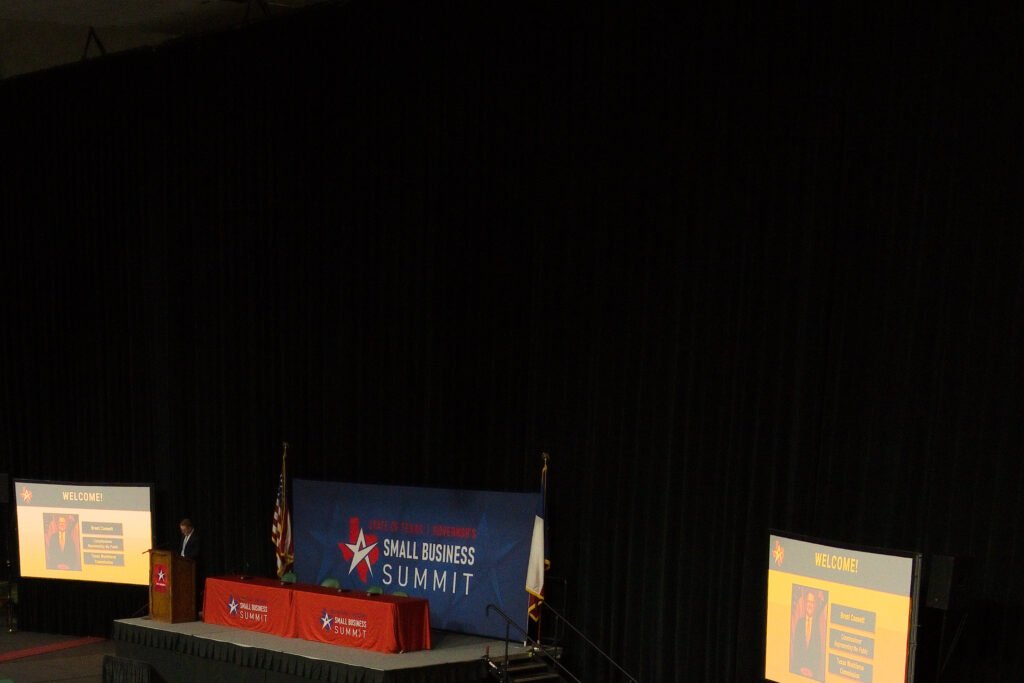
The photo at the top of this post is a good example. It’s a dim event hall, lit mostly by the stage, with a dark backdrop and a room that was never lit for cameras. It was shot on a Nikon Z9 at 1/400 sec, f/4, and ISO 2,000, with no flash. A slower shutter would have risked blur if anyone on stage moved. A lower ISO would have meant a dark file pushed hard in editing, which is exactly where noise gets ugly. Shot this way, it’s a clean, usable image that holds the room as it actually looked.
A simple low-light starting point for event photos
- Set shutter speed for what is moving. Speakers at a podium and people mingling can usually be frozen around 1/125 to 1/250 sec. Dancing, awards walks, and kids need faster. Static room details can go slower.
- Choose aperture for how much needs to be sharp. One person can be shot wide open. A group of three or four, or a head table, usually needs a little more depth, such as f/2.8 to f/4.
- Put ISO on auto with a ceiling you trust. Find your own limit by shooting one scene at every ISO, doubling from 100, and noting where the noise starts to bother you. Then set your auto ISO ceiling a notch or two above that, because modern noise reduction recovers more than you might expect.
- Expose correctly in camera. A correctly exposed high ISO file holds up far better than an underexposed low ISO file brightened later. Watch the histogram, and keep bright spots like stage lights and white linens from clipping.
- Clean up color noise, keep a little grain. Color noise (the blotchy rainbow speckles) is the ugly kind and is easy to remove. Fine luminance grain often looks natural, almost like film, and most viewers on a phone will never notice it.
Remember Lambert’s own mistake: he once came home with an ISO 16,000 frame in full daylight because he forgot to change a 1/2,000 sec shutter speed from an earlier action scene. The camera did its job. The setting to blame was the shutter speed, so recheck it every time the scene changes.
What this means if you’re hosting an event
- You don’t have to light the room like a TV studio. A skilled photographer with modern gear can work with ambient light, so your decor and mood lighting still show up in the photos.
- A little more light still helps. If there’s a key moment like a toast, award, or first dance, ask your venue or DJ to bring the lights up slightly for that moment. It gives you crisper photos of the parts that matter most.
- Ask your photographer how they handle dark venues. It’s a fair question. Fast lenses, modern bodies, and a plan for flash versus ambient light are what make low-light coverage look natural.
- Headshots are different. For team headshots at your office we bring our own lighting, so the room lights matter much less. Low ISO and controlled light are the goal there.
Gear that helps in dark venues
Gear doesn’t replace good settings, but a body that holds up at high ISO and a fast lens give you more room to protect your shutter speed:
- Buy at Adorama: Nikon Z8
- Buy at Adorama: Nikon Z9
- Buy at Adorama: NIKKOR Z 24-70mm f/2.8 S
- Buy at Adorama: NIKKOR Z 50mm f/1.8 S
Disclosure: some links in this post are affiliate links, which means Grey Bug Photography may earn a small commission if you buy through them, at no extra cost to you.
The takeaway
Noise isn’t caused by a high ISO number. It’s caused by too little light. Set your shutter speed for the moment, your aperture for the subject, and let ISO fill in the rest. A slightly grainy photo of a great moment can be cleaned up. A blurry one can’t.
Source: Alex Cooke, “Why ISO Doesn’t Create Noise, and Why It Should Be the Last Setting You Pick,” Fstoppers, November 17, 2026, featuring a video by Pierre T. Lambert.
Planning a gala, holiday party, or evening event in San Antonio or anywhere in Texas and want photos that look great even when the lights are low? Reach out to Grey Bug Photography, or see how we work with planners on our For Planners page.