Every photographer has an opinion about prime lenses versus zooms. The people actually spending money seem to have made up their minds. On November 23, PetaPixel reported on the latest top 10 best-selling lenses at Yodobashi Camera, one of Japan’s biggest camera stores, and nine of the ten were zoom lenses.
As a Nikon Z9 and Z8 shooter who spends a lot of time in ballrooms, conference halls and outdoor ceremonies, that did not surprise me at all. Here is what the chart shows, and what it means if you are hiring an event or headshot photographer in San Antonio, or buying a lens for yourself this holiday season.
What the best-seller list shows
The chart covers the second half of October and was first reported by CAPA Camera Web. A few things stand out:
- Zooms dominate. The list includes the Sony FE 24-70mm f/2.8 GM II, the Sony FE 70-200mm f/2.8 GM OSS II, the Canon RF 70-200mm f/2.8L IS USM Z, the Canon RF 100-400mm, the Tamron 25-200mm f/2.8-5.6 G2 and the Nikon Nikkor Z 70-200mm f/2.8 VR S II.
- Only one prime made it. The lone prime was Sony’s new FE 600mm f/6.3 GM OSS, a specialty super-telephoto for wildlife and sports, and the most expensive lens on the list.
- A new APS-C zoom is a hit. Sigma’s 50-120mm f/2.8 DC OS Contemporary appeared three times, once each for Fujifilm X, Canon RF and Sony E mount.
- It is not a one-off. PetaPixel notes that almost all of Map Camera’s best-selling lenses of 2025 were zooms too.
It is data from one retailer in one country, so it is not the whole market. But camera companies share very little sales data, so charts like this are some of the best clues we get about what photographers really buy.
Why zooms win at real events
Primes are wonderful lenses, and many photographers love them for portraits. At a live event, though, flexibility usually matters more than the last bit of sharpness or background blur. Here is why the 24-70mm and 70-200mm f/2.8 zooms are the workhorses of event photography:
- You cannot move the room. Guests, tables, cameras and stage setups are where they are. A zoom lets the photographer reframe from the aisle or the back of the room instead of walking in front of the audience.
- Moments do not wait for lens changes. A keynote laugh, an award handoff or a first dance happens in a second. Going from the full stage to a tight shot of the speaker with a twist of the zoom ring means fewer missed moments.
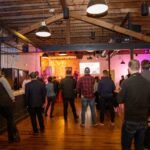
- Wide and tight from the same spot. The photo above is the wide end of the story: the whole stage, the banner and the audience. From the same spot, a 70-200mm can pull in the speaker or the toast without anyone noticing the camera.
- f/2.8 handles indoor light. Ballrooms and conference halls are darker than they look. A constant f/2.8 aperture, paired with the high-ISO performance and fast autofocus of cameras like the Nikon Z9 and Z8, keeps shutter speeds fast enough to freeze people moving.
- Quieter coverage. Shooting from a distance with a telephoto zoom lets people act naturally. Candid photos almost always look better than posed ones at events.
Where primes still make sense
Zooms are not the answer to everything. A fast prime like an 85mm can be a great choice for controlled portraits and very dark rooms, and specialty lenses like that 600mm have their place in sports and wildlife. For mixed event coverage, though, most working event photographers lean on zooms for most of the day and pull out a prime only when it clearly helps.
What it means for headshots
A 70-200mm is not just an event lens. At longer focal lengths, faces look natural and well proportioned, and the background softens and simplifies. That is a big reason headshots taken with a telephoto lens often look more flattering than a close-up phone photo. If you are planning professional headshots for yourself or your team, the lens choice is one of the quiet reasons the results look polished. Sharpness still depends on focus and technique, which we covered in our post on why headshots can look soft even with great gear.
Questions to ask your event photographer
- Will you bring both a wide-to-standard zoom and a telephoto zoom?
- Can you cover the stage from the side or back without blocking guests or video cameras?
- How do you handle dark venues without flash ruining the mood?
- Do you bring a backup camera body in case something fails mid-event?
Clear answers to those questions tell you a lot more about your final photos than a list of camera brands.
Shopping for a lens this holiday season?
If you are a hobbyist or the person who takes photos at your company’s events, a good zoom is the most useful upgrade you can make. Black Friday deals are already live across many brands. A few lenses from the chart and their Nikon counterparts:
- Nikon Nikkor Z 70-200mm f/2.8 VR S II for stage, speakers and candids from a distance: Buy at Adorama
- Nikon Nikkor Z 24-70mm f/2.8 S II as an all-day standard zoom for full-frame Nikon Z bodies: Buy at Adorama
- Sigma 50-120mm f/2.8 DC OS Contemporary for APS-C Fujifilm, Canon and Sony shooters who want a bright telephoto zoom: Shop Sigma 50-120mm at Adorama
If you shoot a Nikon DX body, our look at the Tamron 16-50mm f/2.8 for Nikon Z covers a budget-friendly standard zoom option.
Disclosure: some links in this post are affiliate links, which means Grey Bug Photography may earn a small commission if you buy through them, at no extra cost to you.
The takeaway
The lens chart confirms what event photographers already know: versatility wins. A good pair of f/2.8 zooms lets a photographer cover the whole room, catch the quick moments and stay out of the way, which is exactly what you want at your conference, gala or holiday party.
Source: PetaPixel, “Sony and Sigma Break Through With Their Newest Lenses,” November 23, 2026, citing Yodobashi Camera sales data reported by CAPA Camera Web.
Planning an event or team headshots in San Antonio? See our event photography page or contact Grey Bug Photography to talk about your date and venue.