Most of us will never photograph a solar eclipse from behind the Moon. The Artemis II crew did, with a Nikon Z9, and this week a new version of that eclipse made the rounds in the photo world. On November 21, Nikon Rumors published a guest post by Stefano Ivan Stinga, an amateur astrophotographer in Osaka, Japan, who combined 62 of the crew’s Nikon Z9 RAW files into a single HDR picture.
We shoot San Antonio events and headshots on the Nikon Z9 and Z8, the same camera family that flew around the Moon. The space part is amazing, but the most useful part for everyday photography is how the picture was made: real RAW files, many exposures and careful blending, with nothing generated by AI. That same idea quietly helps a lot of event photos look right.
What happened on Artemis II
Here is the short version, based on the guest post:
- The moment: on April 7, 2026 (UTC), during the Artemis II lunar flyby, the Orion spacecraft passed through the Moon’s shadow. For close to an hour, the crew watched the Sun hidden behind the far side of the Moon.
- The gear: they photographed it through Orion’s window with a Nikon Z9 and an older AF Nikkor 35mm f/2D lens on an adapter.
- The files: NASA released the RAW files to the public through its Planetary Data System on October 7.
- The exposures: the crew changed the shutter speed during the eclipse from 1/40 second to 13 seconds, a spread of about nine stops of light. A single frame shared in the post was a 1-second exposure at f/2 and ISO 1600.
- The result: Stinga stacked the frames to bring out the faint glow of sunlight scattered by space dust, an Earthlit sliver of the Moon, thousands of stars, and several planets lined up along the plane of the solar system.
He says he calibrated and aligned every frame with his own software, combined the sharpest frames for the Moon, and finished with HDR tone mapping so the bright glow and faint stars could fit in one image. He also says nothing was cloned or generated with AI. Earlier this year, Nikon Rumors covered researchers who studied the same glow from one of the crew’s JPEGs. Going back to the RAW files is what made this deeper version possible.
Why one frame was not enough
No camera can record the darkest and brightest parts of a scene like this in a single click. Expose for the faint stars and the bright glow blows out. Expose for the glow and the stars disappear. The answer was to shoot a range of exposures and blend them.
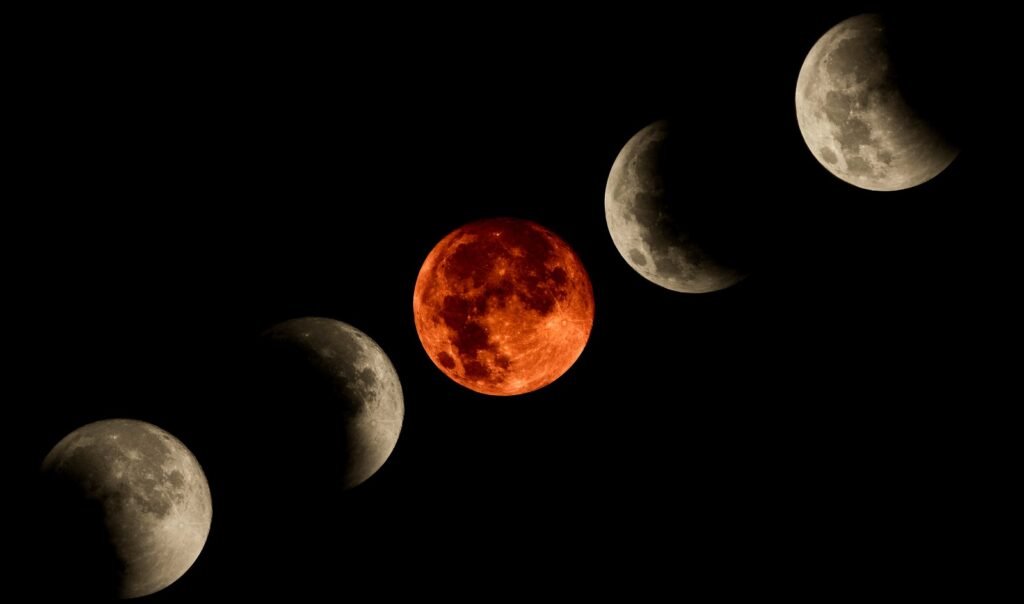
The photo at the top is a much simpler example of the same idea. It is a lunar eclipse we photographed in 2015, shown as five separate exposures of the Moon combined into one picture. Each phase needed its own exposure, because the red, fully eclipsed Moon is far darker than the bright partial phases.
Where this shows up at San Antonio events
You do not need a spacecraft to run into high contrast. We see it all the time at local events:
- Speakers in front of bright windows, where the room is dark and the outside is blazing.
- Churches and historic venues with stained glass, candles and deep shadows.
- Stage lighting that puts a bright spotlight on a face and leaves the rest of the stage black.
- Outdoor evening events where the sunset sky is far brighter than the guests on the patio.
For moments with people, we usually work with one well-exposed RAW file and our lighting, because people move and blending frames of moving people rarely works. For the room itself, such as a wide shot of a decorated ballroom or a historic hall, we can bracket a few exposures on a tripod and blend them so the windows and the room both look natural. Either way, it starts with shooting RAW.
RAW files matter more than most people think
A RAW file keeps far more highlight and shadow information than a JPEG straight out of the camera. On our Z9 and Z8, we shoot RAW at every event and headshot session. That gives us room to bring back a bright window, open up a dark corner, or fix mixed color from stage lights, all without faking anything.
It is the same reason the Artemis II RAW files were worth revisiting months later: the information was there, waiting to be pulled out with care. We wrote about why ISO does not actually create noise, which is part of the same story about getting clean files in dark venues.
Real pixels, not invented ones
One part of this story we really like is the note that nothing was generated with AI. Every star in the final picture was measured from the real frames. That lines up with how we approach event and headshot editing. We fix light, color and exposure, but we do not invent people, places or moments that were not there. We touched on this in our post about a survey showing many smartphone photos do not match reality.
Tips for photographing your own high-contrast scenes
- Shoot RAW whenever your camera allows it, even on a phone that offers a RAW mode.
- Turn on exposure bracketing for still scenes like venues, décor and architecture, then blend in Lightroom’s HDR merge.
- Use a tripod or brace the camera so the bracketed frames line up.
- Expose for the highlights on people, then lift shadows later. Blown-out highlights are much harder to recover than dark shadows.
- Do not rely on one frame for once-in-a-lifetime moments. Take several, with a few different settings.
Gear mentioned in this post
- Nikon Z9, the camera used on Artemis II and one of our main event cameras: Buy at Adorama
- Nikon FTZ II mount adapter, for using older F-mount lenses like the AF Nikkor 35mm f/2D on Z cameras: Buy at Adorama
- Nikon Z8, the smaller sibling with the same sensor family: Buy at Adorama
Disclosure: some links in this post are affiliate links, which means Grey Bug Photography may earn a small commission if you buy through them, at no extra cost to you.
If you are shopping for a Z camera this season, we also wrote about the Nikon Z8 Black Friday price cut.
The takeaway
The Artemis II eclipse picture is a reminder that great images often come from good RAW files, smart exposure choices and honest editing, not from one magic click or an AI button. The same habits make a dark ballroom, a bright window behind a speaker, or a stained-glass venue look the way it felt to be there.
Source: Nikon Rumors guest post by Stefano Ivan Stinga, November 21, 2026 (images: NASA/Artemis II crew, from the NASA Planetary Data System).
Planning a conference, gala or team headshot day in San Antonio? See our event photography and headshot photography pages, or contact Grey Bug Photography to talk about your date.